News Story
Miles Davis remains one of the most iconic figures in jazz history. His unstoppable drive for innovation inspires generations of musicians to this day and extends beyond his own time. In the year he would have turned 100, Brussels Jazz Orchestra and trumpeter Ambrose Akinmusire join forces for a unique project that does not look back out of nostalgia but looks forward with a fresh, contemporary vision.
Ahead of their performance at Town Hall on 27 April, B:Music spoke with Lennert Baerts, saxophone player, composer and artistic project leader with Brussels Jazz Orchestra.
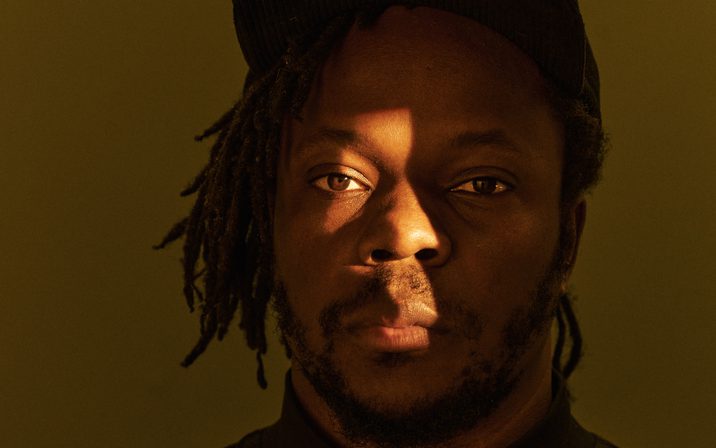
Book now: (...) What's Not There: A New Perspective on Miles
Mon 27 April | Town Hall | 7 :30PM
“My earliest musical memories are of hearing music by Mahler and Brahms on the radio at home. I grew up in a very musical family. My mother is a conductor, and almost everyone in my family, except my grandmothers, played in a concert band. I was constantly surrounded by music, particularly classical wind band repertoire,” he says. “The first instrument I was given was a flugelhorn. In hindsight, it was a fascinating way to develop a sense of pitch, because I did not yet understand how the valves worked. I had to rely entirely on my embouchure to control the pitch.
Later, my parents tried to introduce me to piano lessons, but that approach, working from written notation, did not appeal to me at all. I was much more interested in improvising and discovering how the instrument worked on my own. Eventually, my father gave me a saxophone. Both my father and grandfather were saxophone players, and aside from showing me the basic hand positions, I largely taught myself through trial and error.”
In many ways, I still approach music like that today—I am still exploring and trying to figure things out.
When asked about his most influential musicians on his journey, Lennert lists a few.
“One of my earliest encounters with jazz was through Charlie Parker, particularly his recordings with strings. I was fascinated by the sound, the freedom, the phrasing, and the energy. When I first entered the conservatory, I was essentially trying to imitate that language.
Later, I discovered Chris Potter, who remains one of my greatest sources of inspiration. Whenever I feel uninspired, I only need to listen to a few seconds of his playing, and it motivates me to practise intensely for weeks. His playing is incredibly rich, engaging, and compelling.”
As a composer, his influences are quite broad. “The music of Mahler and Brahms, which I heard as a child, has stayed with me and resonates in composers like John Williams. However, one of the most decisive influences on my development as a composer was Frank Zappa. He showed me that composition can exist in any context, for any ensemble, and that it is entirely possible to be both a composer and a performer. I used to struggle with that question, but seeing how he navigated both roles helped me realise that there is no need to choose.”
“John Coltrane was also a crucial figure for me. His music opened up entirely new ways of approaching the tenor saxophone, improvisation, and the expressive potential of music. In many ways, my development as a creative musician began there.”
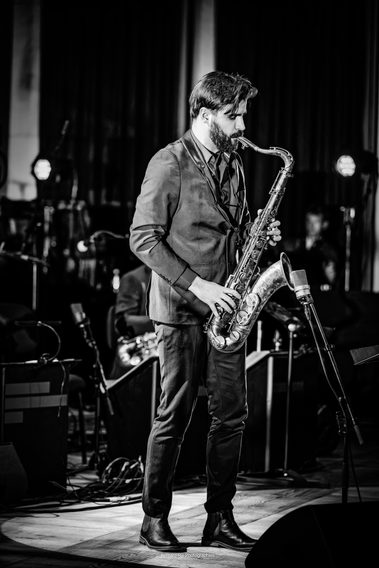
He also mentions the influence of Ambrose Akinmusire who will be joining Lennert and Brussels Jazz Orchestra this month. “During my studies at the Conservatory of Antwerp, I had the opportunity to work closely with him on a project based on his album ‘The Imagined Saviour Is Far Easier to Paint’. We rehearsed for a week and performed several concerts together. His artistic vision, his professionalism, and his approach to translating musical ideas into sound had a profound impact on me. That experience was, without doubt, one of the most formative moments in my musical development.”
I would say the most valuable mindset is to keep things playful.
It is important to listen carefully to others, especially your teachers, but not to accept everything uncritically. You need to test ideas for yourself, to question them, and to make them your own. Stay curious, keep exploring, and do not limit yourself to what is presented within formal teaching structures.
Teachers can guide you, but they are most helpful when you bring your own curiosity and ask meaningful questions. That, I think, is when real learning happens.
“What interests me most is the balance between freedom and structure,” says Lennert when asked about how he approached the music of Miles Davis for this performance. “Miles seemed to rely on a strong framework, while his band brought multiple perspectives – Wayne Shorter, Herbie Hancock, and others each contributed their own voice, creating something entirely new in real time.
What fascinates me is that, despite their freedom, the essence of the composition always remained present. There was a deep level of focus and connection within the group.”
Miles Davis famously said: “Don’t play what’s there, play what’s not there.”
“This idea operates on multiple levels,” says Lennert. “Not only in performance, but also in composition and interaction. As a composer, I begin by identifying the essential elements of the music and then building a new structure around them. In doing so, I already engage with what is not explicitly present.”
“In rehearsal, the challenge is to move beyond the written score. Instead of functioning as a traditional orchestra, we encourage the big band to operate more like a small ensemble—a quartet or quintet on a larger scale. This means allowing for flexibility, leaving certain aspects undefined, and creating space for spontaneous interaction. In that space, musicians can respond to the energy around them, sometimes by playing, sometimes by choosing not to play. It becomes a matter of imagination, balance, and communication.”
Simply reproducing what is written is often less interesting than what you choose to add or deliberately leave out. That is where the music becomes alive.
“For me, every arrangement is a narrative. While one can analyse the technical or theoretical aspects, what truly matters is the sense of storytelling,” says Lennert. “What I find most compelling about Miles Davis’s bands is their ability to create these narrative arcs, complete with tension, release, climaxes, and moments of stillness. There is a sense of structure, almost like a story with a beginning, development, and conclusion.”
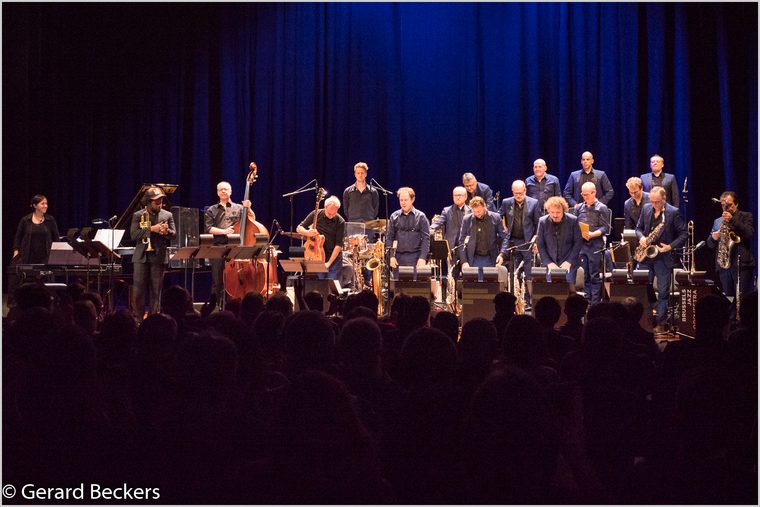
“This is very much how we approach our own work. Some of the pieces are quite extended, with carefully shaped climaxes, but also with open, uncertain spaces, moments where the story is not predetermined, where there is doubt or ambiguity.”
On 27 April, Town Hall will see Ambrose Akinmusire alongside Brussels Jazz Orchestra celebrate and interpret the music of Miles Davis. “I hope that the audience experiences these performances almost like a series of small films or paintings. They are invited to use their own imagination to fill in the gaps, to interpret what is not explicitly stated.”
“In that sense, what is not there becomes just as important as what is. It is about how each listener reads between the lines and brings their own perspective to the experience.”
Don’t miss Brussels Jazz Orchestra and trumpeter Ambrose Akinmusire join forces for a unique project that does not look back out of nostalgia but looks forward with a fresh, contemporary vision of the music of Miles Davis on 27 April at Town Hall.